Sankar Arumugam Receives Fulbright-Kalam U.S. Scholar Award for 2025-2026
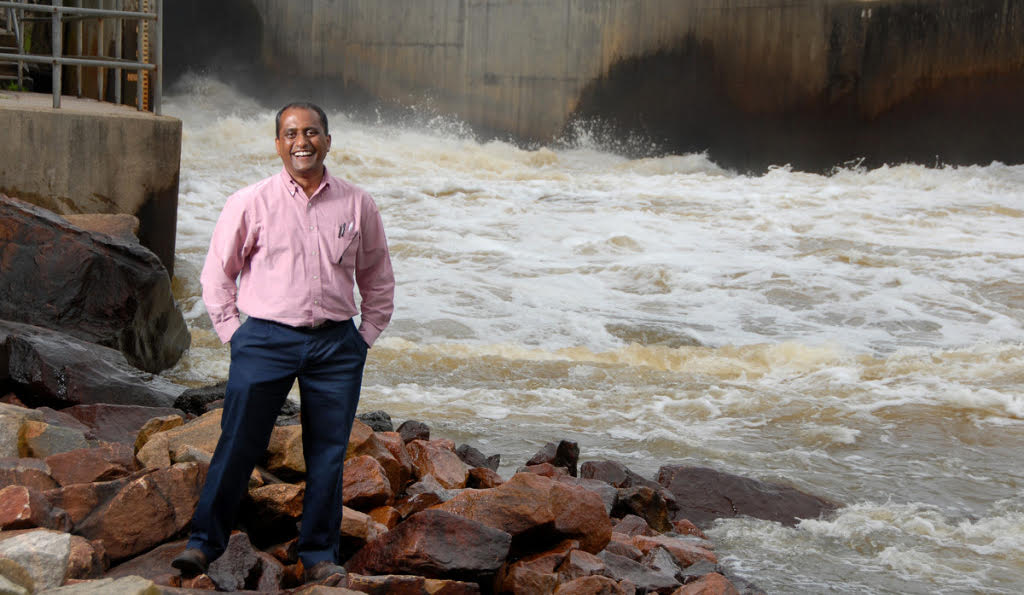
Dr. Sankarasubramanian Arumugam, a Professor and University Faculty Scholar in the Department of Civil, Construction, and Environmental Engineering at North Carolina State University, has received a Fulbright-Kalam U.S. Senior Scholar award in Water Resources Engineering to India for the 2025-2026 academic year from the U.S. Department of State and the Fulbright Foreign Scholarship Board.
Arumugam will use his Fulbright award to advance research on utilizing hydroclimate information for improving Food-Energy-Water (FEW) management in India and in the U.S. He will conduct workshops on incorporating hydroclimate information to improve FEW System resilience under operation and planning. He will also offer short-term courses in several Indian educational institutions on the state-of-the-art modeling tools in FEW system management.
“This Fulbright-Kalam award provides me an opportunity to address a critical problem of managing FEW resources in India, where stressors from development and changes in lifestyle along with changing climate present a complex problem,” Arumugam said.
As a first-generation college graduate from India, this Fulbright fellowship also provides a great opportunity for Arumugam to work on the pressing problem of Climate and FEW System security in India by collaborating with several Indian educational institutions and agencies.
“Thanks to Fulbright, this prestigious fellowship presents a great opportunity to work in India where I grew up to address one of the complex problems, FEW system management, as it continues to constrain resource availability,” he said.
Arumugam is also affiliated with the department’s Environmental, Water Resources, and Coastal Engineering and Computing and Systems groups, and leads the Climate, Hydrology and Water Resources: Modeling and Synthesis research group.
This Fulbright-Kalam fellowship will also support Arumugam’s ongoing multinational NSF-funded AccelNet project on advancing subseasonal-to-seasonal climate information for improving water, food, and energy systems in India, Brazil, and Africa and nicely builds on his leadership on several NSF flagship initiatives on Climate and FEW System Sustainability. The proposed Fulbright-kalam research also strongly aligns with NC State’s strategic priorities in global engagement and sustainability.
Fulbright U.S. Scholars are faculty, researchers, administrators, and established professionals teaching or conducting research in affiliation with institutes abroad. Fulbright Scholars engage in cutting-edge research and expand their professional networks, often continuing research collaborations started abroad and laying the groundwork for forging future partnerships between institutions. Upon returning to their home countries, institutions, labs, and classrooms, they share their stories and often become active supporters of international exchange, inviting foreign scholars to campus and encouraging colleagues and students to go abroad.
Since 1946, the Fulbright Program has provided over 400,000 talented and accomplished students, scholars, teachers, artists, and professionals with the opportunity to study, teach, and conduct research abroad. Fulbrighters exchange ideas, build people-to-people connections, and work to address complex global challenges. Notable Fulbrighters include 62 Nobel Laureates, 93 Pulitzer Prize winners, 82 MacArthur Fellows, 44 heads of state or government, and thousands of leaders across the private, public, and non-profit sectors.
Over 800 individuals teach or conduct research abroad through the Fulbright U.S. Scholar Program annually. In addition, over 2,000 Fulbright U.S. Student Program participants—recent college graduates, graduate students, and early career professionals—participate in study/research exchanges or as English teaching assistants in local schools abroad each year.
Fulbright is a program of the U.S. Department of State, with funding provided by the U.S. Government. Participating governments and host institutions, corporations, and foundations around the world also provide direct and indirect support to the Program, which operates in over 160 countries worldwide.
In the United States, the Institute of International Education implements the Fulbright U.S. Student and U.S. Scholar Programs on behalf of the U.S. Department of State. For more information about the Fulbright Program, visit https://fulbrightprogram.org.
- Categories: