Improving Safety When Transporting Radioactive Material Using Composite Metal Foam
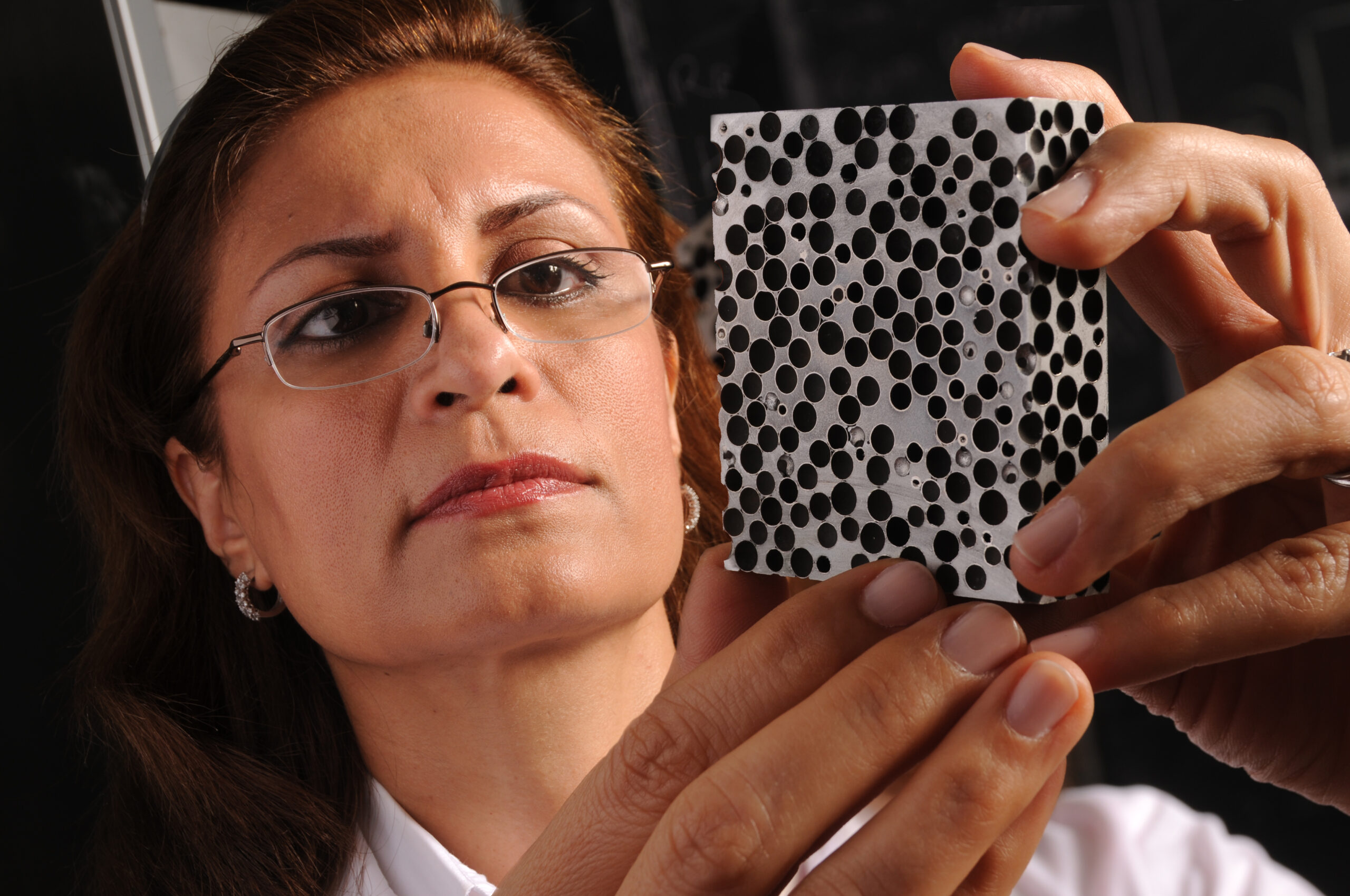
A safer, easier way to transport nuclear fuel may be on the horizon, thanks to researchers at NC State.
On March 3, 2026, the U.S. Department of Energy’s Nuclear Energy University Program (DOE-NEUP) announced its latest funding for projects related to nuclear technologies; NC State’s College of Engineering earned more than any other institute.
One of the funded projects is a joint effort between the Department of Mechanical and Aerospace Engineering (MAE) and the Department of Civil, Construction and Environmental Engineering (CCEE).
The project, “Novel Lightweight Material for Spent Nuclear Fuel Transportation,” is led by inventor and MAE Professor Afsaneh Rabiei with collaboration from CCEE Professor Gregory Lucier.
Experimenting with Composite Metal Foam
This project aims to improve safety when transporting depleted nuclear fuel.
When nuclear fuel is spent, it must be moved from a nuclear reactor site to a waste facility. These transits can be dangerous, as any impact or crash could lead to radioactive material leaking into the environment. Currently, spent nuclear fuel is transported in packaging that weighs roughly 100 tons, making it extremely large and difficult to transport.
Enter composite metal foam (CMF), a material invented by Rabiei that is as strong as steel and light as aluminum with applications including aerospace, defense and hazardous waste transportation – specifically, aircraft wings, vehicle armor, body armor and HAZMAT transportation tank cars. A composite made up of hollow metal spheres and a metal matrix, CMF is great at insulating against high heat and fire and acts as “metal bubble wrap” around the nuclear waste casks.
“By utilizing CMF, with a combination of lightweight, high strength and excellent thermal insulation properties, we aim to make nuclear waste casks lighter, smaller, more robust, cost-effective and safer,” Rabiei said.
With funding in place, researchers will begin creating protective devices, called impact limiters, made of CMF.
A Collaborative Effort
The project will take place in three phases: designing, manufacturing and testing.
MAE researchers will design scaled prototypes of the impact limiters using numerical modeling, essentially, running computer simulations to predict outcomes and meet U.S. Nuclear Regulatory Commission (NRC) certification requirements.
The manufacturing of the scaled prototypes will be handled by Advanced Materials Manufacturing (AMM), a small business founded by Rabiei. The company’s goal is to commercialize CMF as a lightweight alternative material that can help protect people and assets in high-risk environments, such as nuclear reactors.
Finally, CCEE researchers will perform crash tests on the prototypes in NC State’s Constructed Facilities Lab. During this testing phase, the prototypes will be dropped from heights of about 30 feet to study and improve their durability.

“They’ll free fall, they’ll impact into the floor, and we’ll take some data from that to inform the design of the impact limiters specifically,” Lucier, who manages the lab, said.
This three-year project received $1 million in funding from the DOE-NEUP. It’s one of six upcoming DOE-NEUP funded projects at NC State that will help make next-generation nuclear reactors safer and more sustainable.
“This is a very nice collaboration between government, academia, industry and different NC State departments focused on a topic that’s important for the safety and security of both people and the environment,” Lucier said.
Learn more about the other DOE-funded nuclear projects at NC State.