‘It Will Pay Off’ | Ph.D. Student Thomas Thelen Highlights Importance of Communication in Research
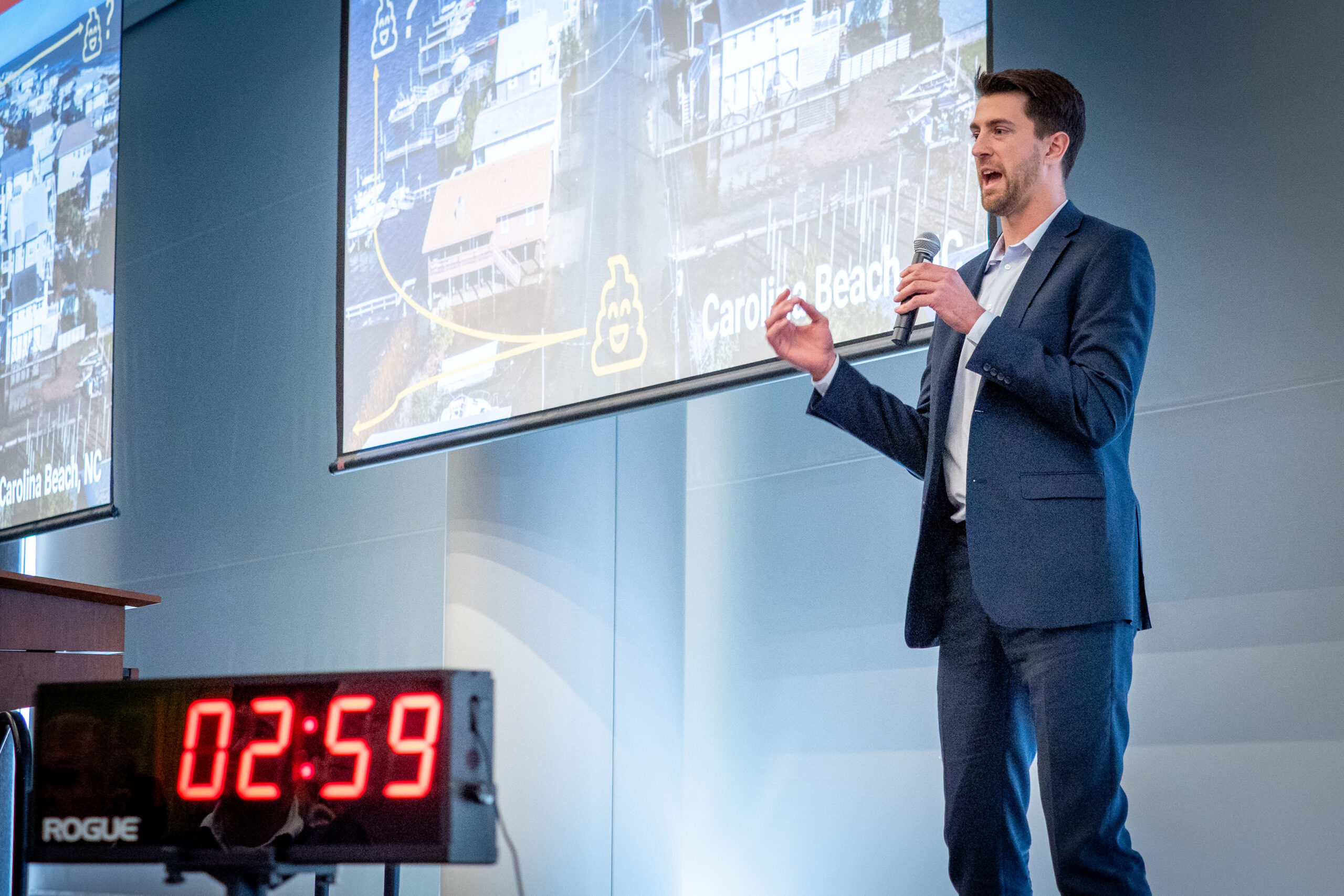
Graduation is right around the corner for Ph.D. student Thomas Thelen. As he finishes his journey at NC State’s Department of Civil, Construction and Environmental Engineering (CCEE), he’s leaving with a key takeaway: communication is critical.
“When you get into applied science, the way you communicate your research can be almost as important, or maybe as important, as the research itself,” Thelen said.
From studying coastal flooding on Carolina Beach to winning a thesis competition, Thelen has learned how to explain complex topics and their real-world impact.
“I’m so grateful for the ecosystem here at CCEE,” Thelen said. “It’s a very collaborative place where you’re encouraged to think beyond your research project or your silo.”
A major highlight of Thelen’s nearly five years at CCEE was the Three Minute Thesis (3MT) competition. Organized by Meagan Kittle Autry, CCEE director of graduate professional development and associate teaching professor, the competition requires students to effectively communicate their research to an audience of non-engineers.
The catch: each student gets just three minutes and one static visual slide to explain their thesis topic, and its significance to society.
“The idea is, the presentation should be accessible to a general audience,” Thelen said. “For instance, if my uncle, who’s not an engineer, showed up to the competition, he should understand after those three minutes what it is I do and one or two takeaways.”
Thelen took home the first-place prize in 2025 after presenting his research on water quality concerns caused by coastal flooding.

Another highlight for Thelen was his work with the Sunny Day Flooding Project team, led by Assistant Professor Katherine Anarde. He and the rest of the team collected field data, ran computer models and conducted surveys in the town of Carolina Beach to better understand flooding caused by sea-level rise.
“One of the takeaways from this research was that wind was a pretty important factor,” Thelen said. “It was kind of one that was flying under the radar, but now that sea levels are higher on average, even just a little bit of wind can cause a lot of flooding.”
Through his mentorship from Anarde and Kittle Autry, Thelen was able to confidently explain his research findings to the Carolina Beach community.
“I’ve been grateful to have mentors like Dr. Kittle Autry and my advisor, Dr. Anarde, who are really strong not only as scientists or teachers, but have also really pushed me to be a better communicator of my science,” Thelen said. “That has served me really well with things like the 3MT competition but also being able to go into these community settings and present confidently what we found in our research.”

For students interested in pursuing research, Thelen recommends taking full advantage of departmental resources, like the CCEE Graduate & Postdoc Professional Development Office. He also recommends working with faculty to improve one’s public speaking skills.
“It will pay off not only in your research but down the line as you sit for job interviews or apply for faculty positions. Those skills are a multiplier on your ability to do really good work,” he said.
After graduation, Thelen plans to return to his hometown of Madison, Wisconsin, and work at Baird, where he will continue working on coastal resilience projects.