The Baltimore Bridge Collapse: Understanding Water Currents and a Disaster’s Aftermath
Roadway traffic is an all too common sight in everyday life, but in our increasingly connected world, waterway traffic is catching up.
As global shipping demands increase, ships are increasing in both size and quantity, leading to more ship strikes with bridges. When a moving ship hits another, it is a collision; when a moving ship hits a stationary object, it is an allision.
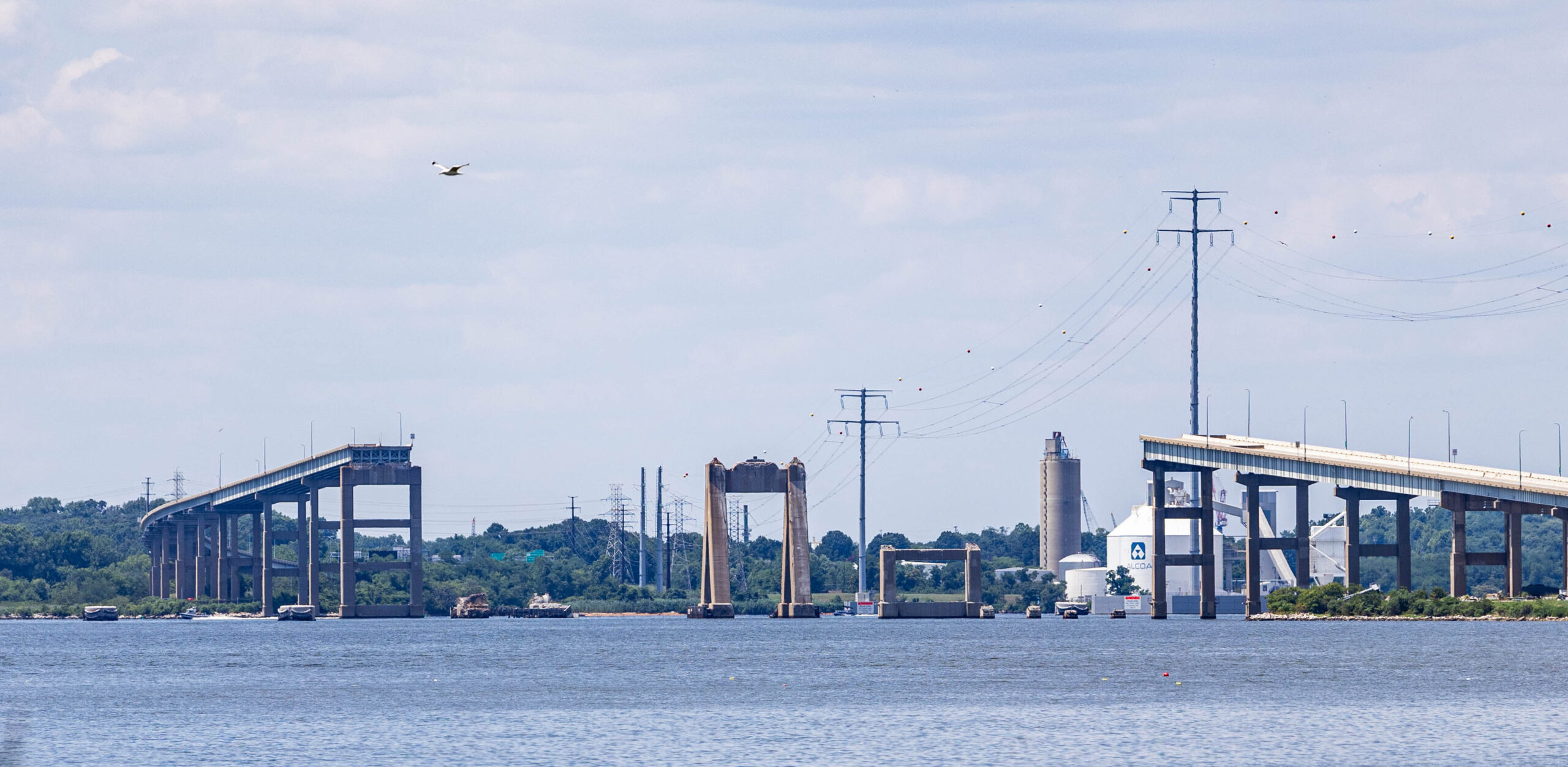
Notably, six people lost their lives when the container ship Dali lost power and allided with the Francis Scott Key Bridge in Baltimore, Maryland, in March 2024. The bridge was destroyed, causing disruptions to shipping and vehicular traffic.
To gain insight into these ship-bridge allisions, a group of researchers investigated how local currents impacted the 2024 disaster. The researchers included North Carolina State University Professor Casey Dietrich, Assistant Professor Jorge San Juan Blanco and Associate Professor Ghadir Haikal, as well as researchers from Nagoya University in Japan.
The research team simulated the Dali wreck using models of the local water currents and ship motion, which predicted the allision timing within 70 seconds of the actual event.
While the simulators don’t explain the whole event, like why the Dali lost power in the first place, the models do explain how the local currents contributed to the ship’s drift toward the bridge.
“The currents were stronger on the ship’s port side, and they caused it to turn southward and allide with the bridge pier,” Dietrich said.
The research team investigated a number of factors that could have influenced the Dali allision, such as channel depth, current speed and sea level rise.
The researchers discovered that the ship’s drift motion was highly sensitive to uncertainties related to both the ship itself and its environment. In fact, they found that if the Dali had lost power just one minute later, the ship would have been much more likely to drift under the bridge unscathed.

The team also studied the consequences of the bridge wreckage. Roughly 50,000 tons of debris fell into the harbor, which led to a blockage in the main water channel.
The blockage caused an increase in current speeds and created navigational challenges in the weeks following the wreck.
“This project is important because it sets the stage for a wider effort when it comes to assessing the damage in bridges caused by ship allisions,” Haikal said. “It is difficult to replicate allision conditions at full scale in a lab experiment. That’s why it is so important to develop a computational model that helps us estimate the forces caused by a ship’s impact to a bridge (at different angles, speeds and positions). Additionally, this computational model helps us predict how the bridge and ship structures will respond to these forces.”
Dietrich credited the experiment’s success to the collaboration between NC State and Nagoya University, which was made possible through a seed grant from NC State’s Office of Global Engagement.

“We needed my model to explain the winds, tides and currents in the larger bay, and we needed [Nagoya University] Professor Tomoaki Nakamura’s model to explain the interactions between the currents and the ship,” he said.
The research group’s findings are important, because they help better our understanding of water currents, ship motion and navigation in harbors.
“Going forward, we hope to expand this project to investigate whether the behavior can be observed in laboratory experiments, and whether we can understand how the allision caused damages to the bridge structure,” Dietrich said.
The team’s research, “Influence of local hydrodynamics on ship drift leading to ship-bridge allisions,” was recently published in Ocean Engineering and is available to read in full online.